Dignity and independence
Women would gain practical skills, opportunities to earn an income and a voice in the farm’s development. The programme will be shaped with communities and partners as rebuilding progresses.

Virgin Mary Farm · For development partners
Help restore water at Virgin Mary Farm so women and families can begin growing, learning and earning again.
Virgin Mary Farm in Omdurman is Risemeup’s main development project. It was destroyed during the war and is not operational. We are seeking water, irrigation and agricultural specialists to help assess the site and design a first growing and training area.
Website updated 27 October 2026 · Well and pump status updated 27 October
Planning and assessment stage; equipment delivery is not yet ready.
Download: partner brief · 27 October 2026 · Version 11
A first stage to develop together
Our immediate aim is a viable water supply and an initial growing and training area. This proposed scope needs technical assessment, agreed responsibilities and funding.
See the illustrated water and reservoir plan →
Inspect the seven wells reported intact and specify replacements for the broken pumps. Design daytime solar pumping, a reservoir or suitable tank storage, filtration and controlled irrigation for an assessed growing and training area. Assess battery storage for agreed electrical loads outside daylight hours. Agree crops, participation and training with the communities.
Agree land-use terms and local responsibilities, confirm safe access and assess the wells, water availability and quality.
Evidence to proceed: dated assessment, well records and agreed responsibilities.
Define the growing area and water system, obtain comparable quotations, and agree training, participation and equipment custody.
Evidence to proceed: technical design, itemised budget, operating plan and funding agreement.
Once funding, access and secure storage are confirmed, procure compatible equipment, install the system, test its performance and train the named operators.
Evidence to proceed: commissioning results, asset register, operator handover and maintenance schedule.
Begin a supervised growing cycle and sustainable farming education. Record water use, crop performance, participation and costs, then decide with communities and partners whether to expand.
Evidence for expansion: first-cycle review and an updated, costed plan.
Timing depends on safe access, assessment findings, written agreements, available funding and procurement. Delivery dates will be agreed after these dependencies are resolved.
The full Virgin Mary Farm vision
The wider vision includes ten greenhouses, biogas, poultry, produce handling and farming education. The Mango Project is a supporting subproject.
The 2018 proposal describes four facility components: what we hope to build. The five-phase recovery roadmap describes how production and facilities could develop gradually. Neither is a current budget or an agreed delivery schedule.
The roadmap explores the 130-hectare site and an ambition to reach 300+ families. Areas and participation are indicative. Any available surplus could support expansion, alongside further partner funding.
Explore the five-phase recovery roadmap →Women and girls at the heart of the project
We plan farming education and livelihood opportunities for women from the Coptic Orthodox, Nuba Mountains and Blue Nile communities affected by war, including survivors of sexual violence, widows and mothers raising children alone.
Women would gain practical skills, opportunities to earn an income and a voice in the farm’s development. The programme will be shaped with communities and partners as rebuilding progresses.
For girls and young women, we plan education and skills opportunities that build confidence and widen future choices. Girls’ learning will be age-appropriate, supervised and designed to support their safety and continued schooling.
Participation must be voluntary and must not require disclosure of violence or trauma. Consultation should address caring responsibilities, travel and accessibility. We welcome women’s organisations and qualified psychosocial partners to help develop support and referral arrangements. These services are not yet established; farming does not replace specialist care.
Everyone working at the farm would receive training suited to their role, including sustainable farming, water management, safe equipment use and maintenance. Induction and continued learning would support each stage.
Dr. Eng. Khalid Salih brings university teaching experience from Berlin and expertise in renewable energy and workforce development. Our training plan will draw on his experience and the practical learning approach of the DIESALIHS Grand Renaissance Academy, alongside agricultural specialists and equipment suppliers. Course content, instructors and delivery arrangements will be developed as the farm is rebuilt.
Virgin Mary Farm · Where we stand
The summary below records the current position. Expand the details for land, management, access and water information supplied by the founder, alongside matters awaiting confirmation.
Iman Tadros confirms that the farm covers 130 hectares (approximately 321 acres) and identifies the landowner as the Coptic Orthodox Church in Sudan, Khartoum–Omdurman. Ownership documents, surveyed boundaries and the authorised Church signatory remain subject to partner due diligence. Cultivable areas and infrastructure allocations will follow site assessment.
Iman confirms that she has the Church’s permission to use the land for the project. The legal recipient, duration, permitted activities and construction rights still need written confirmation. The intended equipment-ownership arrangement is described below; the Church remains the identified landowner.
Founder Iman Tadros coordinates development-partner enquiries and machinery-donation paperwork. She identifies Bishop Sarabon and farm manager Jhone Wadeea as the local contacts in Sudan. Equipment ownership, custody, technical operation and maintenance responsibilities will be documented with the Church and prospective partners before delivery.
The founder reports a visit around mid-October 2026. Its exact date and record remain unconfirmed; it has not been established as a technical assessment.
The recent visit has not been confirmed as a technical assessment. A dated assessment of the wells, water-storage needs and rebuilding requirements is still needed before specifications and delivery plans can be finalised.
Safe access, local permissions and delivery routes must be checked before each visit or shipment. A past visit does not establish that future access is safe.
The founder’s latest update from Sudan reports seven intact wells with broken pumps requiring replacement. It supersedes the earlier account of destroyed wells and stolen pumps. A qualified assessment must inspect the wells and measure sustainable flow, operating water levels and water quality before pumps, power and reservoir storage are specified.
Secure storage and custody arrangements must be assessed and established before equipment is delivered. Detailed security information and exact storage locations will not be published.
Sensitive supporting documents are not hosted on this public website. Prospective partners can discuss document availability and a suitable private review process with Iman. Some records and agreements still need to be obtained or completed.
What support could provide
These six equipment categories support the proposed first water and training system. Specifications and prices will follow assessment; no quotation-backed funding total is available.
The Phase 1 production concept, in pictures
The illustration explores a possible 20–30 hectare production block, beyond the immediate water-restoration stage. The assessed first growing area may be smaller. Equipment categories shown need technical review before procurement.
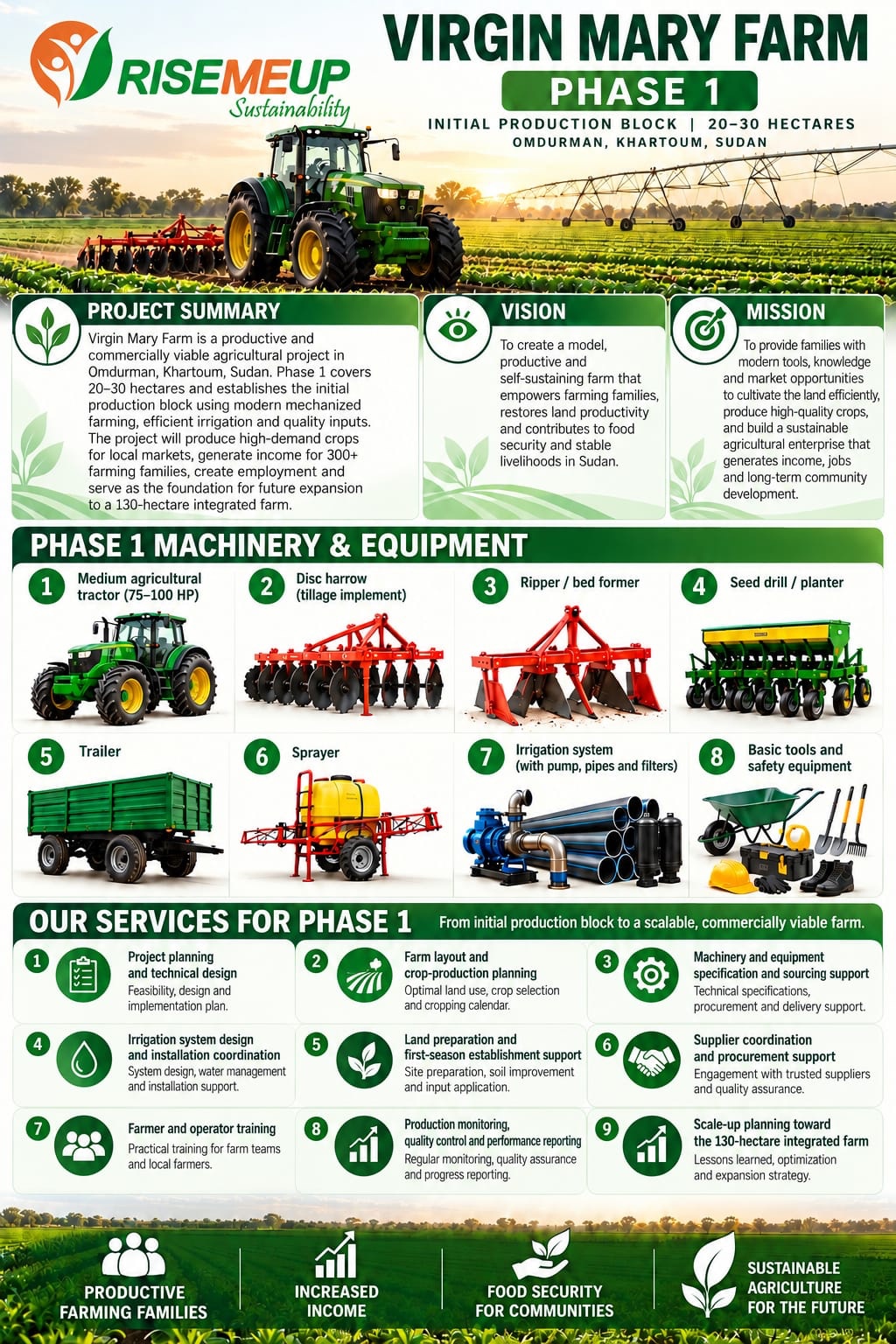
Assessment before procurement. Equipment must suit the assessed water supply, growing area, operators and maintenance arrangements.
1 initial water-source system, subject to technical assessment
Replace broken pumps in the existing wells, following inspection, to restore supply for an initial growing and training area.
1 matched power package for the initial pump
Provide power for the restored water-pumping system, subject to technical suitability.
1 integrated system; tank count and capacity to be determined
Design new reservoir or tank storage for irrigation, with filtration to protect the distribution system.
1 initial growing area; hectares and network length to be confirmed
Deliver measured water to crops and support practical irrigation training.
1 starter package; individual tool quantities depend on the training plan
Enable initial cultivation and supervised sustainable farming education.
1 site protection package; scope to follow the access and security assessment
Protect replacement equipment and provide accountable storage for tools and spares.
Before donating machinery: please agree the specification with us. Compatibility, delivery, installation, local spare parts, servicing and operator training must be included. The tractor and land-preparation implements will be specified once the initial cultivation area is defined.
Funding transparency
No quotation-backed funding total has been set.
We need technical partners to assess the site and develop an itemised first-stage budget.
The budget will cover well inspection, replacement pumps, reservoir or tank storage, power, filtration, irrigation, installation, training, maintenance and contingency, including agreed in-kind support.
Once costs are validated, we plan to publish a dated budget summary and report how agreed support is used.
Help assess and cost the first stage →Community benefit and accountability
The approach below is proposed for agreement with the Church, community representatives and development partners before implementation. These arrangements are not yet adopted operating policies.
Risemeup is a London-based initiative and is not currently registered in the UK. Before accepting project funding or equipment, the legal structure and eligible recipient must be agreed.
Proposed selection would consider household need, displacement, barriers to livelihoods and interest in farming or training. Criteria should be transparent, with a way to raise concerns. Participation should not depend on religious observance.
All three communities would help shape training, schedules and access, with women a priority. Consultation should address the needs of young people and displaced families, including travel, caring responsibilities and accessibility.
Founder Iman Tadros confirms the intended arrangement: donated machinery and project equipment will belong to Virgin Mary Farm together with Risemeup, for the farm’s community purpose. This does not change ownership of the land.
The legal recipient and title, donor conditions, asset custody, maintenance and transfer or disposal rules will be recorded in written agreements with the Church and donors before equipment is accepted or delivered. The proposed income model would support operations, maintenance, education and community benefit; allocations and reporting need governance approval.
Proposed controls include a separate project ledger, documented purchasing and approvals, retained receipts, an asset register and regular expenditure and progress reports. Named oversight and reporting responsibilities must be agreed before funds are received.
Adopted policy documents and responsible officers have not yet been published. Safeguarding, safe recruitment and conduct, confidential complaints, conflicts of interest and financial controls need to be agreed and put into use before activities begin. Approved versions and accessible reporting routes will then be published.
Iman can receive general questions about the proposed arrangements. A formal safeguarding or independent complaints route has not yet been confirmed for publication; please do not send sensitive case details through a general enquiry.
Reference for developing these arrangements: Misereor’s policies, guides and forms. This is a guidance reference, not a claim of partnership or endorsement.
Our planned contribution to the SDGs
Baseline measurements, realistic targets and reporting responsibilities will be agreed during assessment. The measures below describe what we propose to track; they are not achieved results.
Proposed measure: renewable electricity generated in kWh and the share of pumping energy supplied by solar.
First-stage target: to be set after system design.Proposed measure: wells commissioned, cubic metres of water delivered and hectares irrigated.
Proposed initial output: an operational pumping and storage system following well inspection and pump replacement, subject to assessment; area and flow targets pending.Proposed measure: training enrolment, completion and access to livelihood opportunities, with voluntary, appropriate records of participation across the communities.
Targets for women, young people and displaced families to be agreed through consultation.Proposed measure: kilograms of organic material reused and produce losses. Wider biogas and fertiliser measures apply only when those facilities operate.
Baseline and targets to be agreed for the first growing cycle.SDG alignment is Risemeup’s own planning framework. It is not United Nations approval, certification or endorsement. These are proposed project measures, not official UN indicators.
See our four SDG commitments →The story and its records
Our founder’s account and photographs document the story of food support in London during coronavirus and assistance for families in Sudan. Exact photograph dates and distribution totals have not yet been verified for publication.
Organisation names, independent references and documented results will be added only when records and permission to publish are available. No third-party endorsement is implied by the archive.
View the photographs and record notes →Start with a defined contribution
Can you help assess the wells, design irrigation or cost the first water system? Contact Iman with your organisation, expertise and the contribution you would like to discuss.
Download the two-page brief ↓Founder, Risemeup
London · Sudan
Please include your organisation and the component you would like to discuss. We will agree a suitable private channel before exchanging sensitive supporting documents.